Showing posts with label phone. Show all posts

Monday, July 25, 2016

8 things you need to know when buying a Chinese smartphone


In March of this year a list of the world's top phone vendors was published. Twelve names were on it, and of those no fewer than eight were Chinese.
Far from the knock-off merchants they've so often been categorised as, companies such as Huawei, Xiaomi, Vivo and Oppo have been producing quality handsets for a few years now – and they've been almost unstoppable in their advance.
But what does this mean for consumers in the West? On the face of it, not a great deal. These manufacturers have tended to focus largely on China and other emerging markets, particularly India.
For various reasons many of them have, in the main, chosen not to compete in Western markets, only dipping their toes in every now and then – some of this has to do with patent law, which is a story for another day. This means Chinese handsets can be a little tricky to get hold of.
The opportunity does exist for those of you with a little gumption and knowledge to snare yourself a super Chinese smartphone – you can get a cracking deal, with specs to make even the most hardened power hounds weep with envy, often for as little as a third of the price of the well-known flagships.
The buying process is generally very different however, and there are quite a few potential pitfalls that you need to be aware of. So read on for eight top tips on buying handsets from abroad.


1. Research your handset


This may seem like an obvious first step, but the reality is harder than you might think. To begin with it can be hard to come by reliable reviews for many handsets, especially those from lesser-known companies such as Doogee, Elephone and Cubot.
Set a budget for yourself, trawl the web and draw up a list of three or four phones that particularly appeal (for example the Xiaomi Mi5, the Elephone P9000 and the Meizu Pro 6). It's worth noting that the Chinese love their phablets, so those with smaller hands may find their options limited.


2. 4G or no 4G?


Everyone wants super-fast internet on their smartphone, so a key thing to check is whether the phones you're looking at support the correct LTE bands for your country.
For example, many Chinese handsets come without support for Band 20, which is used by O2 in the UK, which would mean you wouldn't be able to get 3G or 4G internet when using these phones on a network that relies on this band.

3. Avoid the update doldrums


The next thing to do is look a little further into the company that makes the handsets. Take Xiaomi for instance. Every phone from the firm comes running MIUI, a proprietary skin of Android. Xiaomi regularly updates its software, bringing new versions of Android to customers at a relatively decent speed (although note that its phones don't come with Google apps or the Play store installed, so you'll need to put those on your phone yourself – see tip #6).
However, Xiaomi's update policy is the exception rather than the rule, so if you plan on keeping your handset for any length of time look for a manufacturer with an established reputation for software update support, otherwise the first bug you find may continue indefinitely.


4. After-sales support


There's another major thing to bear in mind before buying a Chinese smartphone: after-sales support. If you want to be able to access support in the event of problems with your new phone, don't buy 'gray imports'.
With some firms having a limited presence in the West (and in some cases no presence at all), parts and expertise may be hard to come by should a repair be needed, although the situation should improve as Chinese manufacturers become more established.
So check before buying – and if you do make a purchase, try extra hard not to drop your phone from a great height.

5. Choose a vendor


This is perhaps the most important step, as making the wrong choice could mean weeks, and perhaps months, of disappointment and frustration.
Different phone manufacturers sell through different web stores. Meizu and Oppo phones can generally be purchased through Amazon, while Xiaomi devices are usually available from the likes of AliExpress and GearBest.
Where possible, try to use a store that ships stock from a warehouse relatively near to you – for example from Europe if you're in the UK – and also make sure to choose a guaranteed delivery option.
Research each vendor before making a purchase, and pay close attention to user reviews – if several people have had a bad experience that should be a red flag.

6. Free ROM-ing


Due to firewall restrictions in China, the vast majority of Chinese phones come without Google's suite of apps installed. They instead run a custom software package ('ROM') overlaid on top of the core Android platform.
That doesn't necessarily mean you'll be in passion of a dud, as you can get Google's offerings with an international ROM with support for English and Google Play.
Many vendors will give the option to ship with an international ROM, but beware of this as devices bought this way may come preloaded with malware.
Choose a handset with an unlockable bootloader, and preferably with a microSD slot too, and check that an international ROM is available. You can then manually flash the ROM to the phone, minus any potentially nasty malware or unnecessary additional applications.

7. Customs charge


An important point when purchasing any phone from abroad is; be aware of customs. Having a device shipped from the same country will help to avoid this situation, but it isn't always an option.
Often when shipping from China, not only will the device in question take several weeks to arrive, but when it does an extra charge has sometimes been applied, proportional to the cost of the device, potentially up to 20%.
Take care, and definitely factor in this potential extra expense when having products delivered, as otherwise cheap phones can skyrocket in price when extra hurdles are applied, thus negating any cost advantage.

8. Setting up


So you've done it! Every hurdle has been cleared, except making the phone usable. On the setup screen, change the language to English (or your lingo of choice).
This daunting step completed, there remains the issue of installing the Google Play store should it not be present - and should it be possible. On Xiaomi devices this can be accomplished by downloading an app from the Xiaomi store, on others it can require full on flashing.

Round-up

Buying phones from far-flung locales can be a highly rewarding process. If done correctly, you can end up with a powerful, beautiful device with an impressively low price point.
If anything goes wrong however, it can mean that your lovely slice of eastern delight ends up a very decorative paperweight.
Two tenets above all hold true: exercise whatever amount of common sense you may possess judiciously, and become the forum lurker you were born to be, as there is no better source of information than someone who has already made a purchase.


    Best cheap Smartphones in the US for 2016

    Best cheap Smartphones in the US for 2016


    Update: There's a new No. 1 best cheap phone and, no surprise, it's from Motorola. We're reviewing more budget phones than ever, so stay tuned for additional comparisons and ranking changes.
    The best cheap phone in the US is a complicated find. Even in 2016, carriers still love to lock you into contracts for budget phone prices, only to have you pay the full amount back in high monthly fees.
    That's why we have sorted through hundreds of inexpensive smartphones in order to rank the best options that you can buy unlocked without monthly fees and, importantly, without a two-year contract.
    And good news: while many are $200 or less, you'll actually recognize the names: Motorola, Google and Apple. Others may be new to you, namely Alcatel, ZTE and Huawei, but they're just as list worthy.


    Moto E (2015)

    The new Moto E packs LTE and a few sweet upgrades
    Weight: 145g | Dimensions: 129.9 x 66.8 x 12.3mm | OS: Android 6.0 | Screen size: 4.5-inch | Resolution: 540 x 960 | CPU: Quad-core 1.2GHz | RAM: 1GB |Storage: 8GB | Battery: 2,390mAh | Rear camera: 5MP | Front camera: VGA
     * Solid, pint-sized design
     * Extremely cheap price
     * Some display issues
     * Not enough storage
    Motorola has the cheapest name-brand Android phone on the list, and you'll have no trouble wrapping your frugal hands around its small screen.
    The 4.5-inch Moto E display has a 540 x 960 resolution that's a quarter of full HD standards (not Quad HD), but it's just enough to keep Google's colorful Android 5.0 Lollipop operating system looking good.
    Moto E's specs include quad-core processor, 1GB of RAM and 8GB of storage – plus a microSD card slot. That's fine for web browsing, email checking and playing most mobile games.
    Its puny size makes it easily pocketable, while its solid plastic design makes it both water-resistant and tougher to damage than the metal or glass-based phones. Sure, it still looks and feels like a cheap Android phone, but there's no contract.


    9. HTC Desire 626

    It's not the HTC A9, but its cheaper cousin
    Weight: 140g | Dimensions: 146.9 x 70.9 x 8.2mm | OS: Android 5.1 | Screen size: 5-inch | Resolution: 720 x 1280 | CPU: Octa-core 1.7 GHz | RAM: 2GB |Storage: 16GB | Battery: 2,000mAh | Rear camera: 13MP | Front camera: 5MP
    * Bright, sharp screen
    * Customizable interface
    *  Weak camera
    *  Average performance
    You won't find the new HTC 10 on this list, but the Taiwanese phone maker has a budget smartphone that packs solid mid-range specs at a fraction of the price.
    The year-old HTC Desire 626 holds up with a 5-inch display and 720p resolution that's big and sharp for the amount you're paying. It gives HTC's colorful interface a sharpness that makes everything pop.
    Its 16-megapixel (MP) camera and battery life are mediocre compared to what we were expecting, but that's almost universal on smartphones at this price.
    The HTC Desire 626 is all about offering an HTC-built phone with an octa-core processor, and actually paying less than the upfront phone that has a two-year contract.


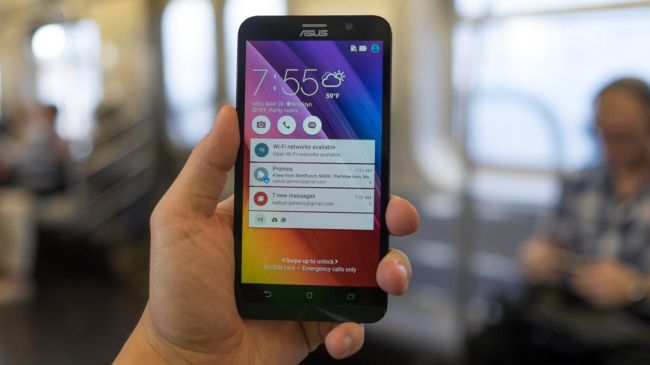
    8. Asus Zenfone 2

    Weight: 170g | Dimensions: 152.5 x 77.2 x 10.9mm | OS: Android 6.0 | Screen size: 5.5-inch | Resolution: 1080 x 1920 | CPU: Quad-core 1.8 GHz | RAM: 2GB |Storage: 16GB | Battery: 3,000mAh | Rear camera: 13MP | Front camera: 5MP
     * Spacious display for cheap
     * Customization interface
     * Cheap look and feel
     * Dim screen and camera
    The more expensive 4GB ASUS Zenfone 2 was a tough sell for me, only because it brought powerful specs and Android customizations, yet wrapped it all in a plastic phone .
    Much less of an oxymoron is the 2GB Asus Zenfone 2, at a more reasonable, It feels just as cheap, but for a much more appropriate price. You just have to deal with its slower processor.
    Intel is powering both variants, and this phone has a 1.8GHz Intel Atom Z3560 quad-core chip, ditching the more commonly used Qualcomm Snapdragon processors.
    Its roomy 5.5-inch display, 1080p resolution and Android software tweaks are the real highlights. Screen brightness and camera are literal lowlights, but you can't win them all with a cheap phone.
    I was able to test out the forthcoming Asus Zenfone 3 Deluxe, but with its more powerful specs and all-metal design, it'll likely cost much more than the cheapest Zenfone 2.


    7. OnePlus X

    OnePlus X can now be sought without an invite code
    Weight: 160g | Dimensions: 140 x 69 x 6.9 mm | OS: Android 5.1.1 | Screen size: 5-inch | Resolution: 1080 x 1920 | CPU: Quad-core 2.3 GHz | RAM: 3GB |Storage: 16GB | Battery: 2,525mAh | Rear camera: 13MP | Front camera: 8MP
    * Attractive design
    * No NFC or fast charging
    *  Bright display
    *  Average performance
    Anyone can buy the OnePlus 3 since it doesn't require an invite, but it's still expensive. Good news: its smaller sibling has been much more affordable since it launched.
    The OnePlus One X is compromises on everything from inches to specs. It has a 5-inch full HD display, a Snapdragon 801 (no, not 810) processor and 3GB of RAM.
    Those are still better than average specs for a cheap phone that runs Android 5.1.1. Just don't go looking for a fingerprint sensor on this budget phone option.
    Instead, what I appreciate most is that the phone features a microSD card slot and an older micro USB port instead of the newfangled USB-C style that I'm just not ready for yet.


    6. Moto X 2nd generation

    Motorola's unlocked phone from 2014 still impresses us
    Weight: 144g | Dimensions: 140.8 x 72.4 x 10mm | OS: Android 6.0 | Screen size: 5.2-inch | Resolution: 1080 x 1920 | CPU: Quad-core 2.5 GHz | RAM: 2GB |Storage: 16GB | Battery: 2,300mAh | Rear camera: 13MP | Front camera: 2MP
    * Great 5.2-inch screen
    * Moto Maker customizations
    * No micro SD slot
    * Camera inconsistent
    Motorola's 2014 flagship is the most expensive phone on this list, but it's also one of the best because it hovers between our best phones and budget lists.
    It has a vibrant-looking, 5.2-inch AMOLED display and a curved back that feels like the right size and shape for a one-handed phone. The aluminum frame gives it some sharp class.
    It's cheaper than most Android 6.0 Marshmallow phones in its class and it has some neat tricks, like the always-on Moto Display and web-based Moto Maker software for custom phone orders. These are features carried over to the newerMoto X StyleMoto Z and Moto Z Force, but at a higher cost.
    There's no microSD slot, unfortunately, and the camera is okay. You'll also want to skip the nice leather option because it's a bit too supple and bruises easily. That back isn't worth your hard-earned money.


    5. Alcatel OneTouch Idol 3

    A cheap 5.5-inch phone from a company you've never heard of
    Weight: 141g | Dimensions: 152.7 x 75.1 x 7.4mm | OS: Android 5.0.2 | Screen size: 5.5-inch | Resolution: 1080 x 1920 | CPU: Quad-core 1.5 GHz | RAM: 2GB |Storage: 16GB | Battery: 2,910mAh | Rear camera: 13MP | Front camera: 8MP
    * Vibrant screen
    * Dual front stereo speakers
    * Sluggish interface
    *  No quick charging
    The Alcatel OneTouch Idol 3 is the best phone with a 5.5-inch display that you can get without having to pay a whole lot of money. Specifically, this Android handset.
    It's an unlocked phone with the same sized screen and pixel density as the iPhone 6S Plus. It even has dual, front-facing stereo speakers, something you won't hear from an Apple phone. Of course, the rest of the specs can't compare to an iPhone, with a much slower Qualcomm Snapdragon 615 octa-core processor running at 1.5GHz and mediocre 13MP camera.
    That should be enough for most people looking for a cheap phone. And think of it this way: you could buy four Alcatel OneTouch Idol 3 phones for the price of one iPhone 6S Plus. Really.


    4. Huawei Honor 5X

    The Chinese phone maker comes to the US with Honor
    Weight: 158g | Dimensions: 151.3 x 76.3 x 8.2mm | OS: Android 5.1.1 | Screen size: 5.5-inch | Resolution: 1080 x 1920 | CPU: Quad-core 1.5 GHz | RAM: 2GB |Storage: 16GB | Battery: 3,000mAh | Rear camera: 13MP | Front camera: 5MP
     * Beautiful design
     * Fast fingerprint sensor
     * Problematic UI
     * Can only buy online
    You can't have a best cheap phone list and not include Huawei, and for the first time in the US, we can include the Chinese company's budget-friendly Honor phone line.
    The newly launched Huawei Honor 5X  phone with a full HD 5.5-inch display and Android 5.1.1, and it looks like its 6-inch cousin, the Huawei Mate 8.
    This Honor phone takes serious design cues from Huawei's premium Mate series, seen in its metal finish that could easily be mistaken for a premium phone that's leagues ahead of the discount handsets.
    It still has a Snapdragon 615 processor, and that problematic, iOS-like user interface that's not nearly as buttery smooth as Apple's operating system, but no one but you will tell under its metal shell.


    3. iPhone 5S

    Apple's iPhone makes the cut if you jump through hoops
    Weight: 112g | Dimensions: 123.8 x 58.6 x 7.6mm | OS: iOS 9 | Screen size: 4-inch | Resolution: 640 x 1136 | CPU: Dual-core 1.3 GHz | RAM: 1GB | Storage:16GB | Battery: 1,560mAh | Rear camera: 8MP | Front camera: 1.2MP
     * Touch ID is easy and secure
     * Great camera on a budget
     * Can be expensive
     * Battery could be better
    It's really, really difficult to fit an Apple phone on a best cheap phones list, but there has to be at least one that's inexpensive enough for iOS fans who refuse to try Android.
    The cheapest is iPhone 5S. Through the Apple Store, without a contract until the iPhone SE replaced it, and that was way too expensive to consider here. But what about outside the usual channels?
    The cheapest iPhone I can find comes from pre-paid carrier Virgin Mobile. and doesn't require a contract, so you can cancel thereafter.
    You're only getting 16GB, but then again, so are entry-level iPhone 6S owners. It comes in space gray or silver, has Touch ID and a still-impressive 8MP camera. It even runs iOS 9 and is poised to get iOS 10.


    2. Nexus 5X

    Google's newest Android phone can be had for a discount
    Weight: 136g | Dimensions: 147 x 72.6 x 7.9mm | OS: Android 6.0 | Screen size:5.2-inch | Resolution: 1080 x 1920 | CPU: Hexa-core 1.8GHz | RAM: 2GB |Storage: 16GB | Battery: 2,700mAh | Rear camera: 12.3MP | Front camera:5MP
     * Marvelous 5.2-inch display
     * Android Marshmallow preloaded
     * Your micro USB cables are useless
     * Can be expensive if not at a discount
    Google's LG-made Nexus 5X almost didn't make the list because it originally launched but the official Google Store briefly dropped the price.
    Well, that means we can permanently recommend this Android 6.0 Marshmallow smartphone. It can run the Android Nougat beta, has a 5.2-inch IPS LCD display on the front and fingerprint sensor on back.
    The Qualcomm Snapdragon 808 processor is one of the best (but not the best) and it has just enough memory, with 2GB of RAM to keep things from slowing down too often.
    While it's plastic, and not metal like the Nexus 6P that launched in tandem, it's only eight months old and is guaranteed to run Android 7 when that launches at the end of summer. It's a sound investment.


    1. Motorola Moto G4

    The best Moto G yet
    Weight: 155g | Dimensions: 153 x 76.6 x 9.8mm | OS: Android 6 | Screen size:5.5-inch | Resolution:1080 x 1920 | CPU: Snapdragon 617 | RAM: 2GB |Storage: 16GB/32GB | Battery: 3000mAh | Rear camera: 13MP | Front camera:5MP
    * Bright Full HD display
    * Impressively powerful
    * Lack of Moto Maker options
    * No NFC
    Motorola has made some major upgrades to one of its best phones you can buy right now - the Moto G.
    The Moto G4 is the first time the phone line has adopted a 5.5-inch Full HD display and it's an impressively powerful device as well. Compared to some of the other phones to follow on this list, this is going to give you the best gaming performance.
    Better yet, if you're willing to put up with lockscreen ads. Battery life is impressive on the Moto G4, but it's not a perfect phone, as there's no NFC and no customization options you get with other Motorola devices.
    That said, the rest of the Moto G4 makes it our favorite cheap phone you can buy right now.